
.
As McKinsey and Deloittes reports have noted. “Just as Lindbergh’s flight is seen as the inception point for today’s $300 billion aviation industry, so too has Rutan’s SpaceShipOne kickstarted a multibillion dollar personal spaceflight industry in just eight years.
“Funding prizes won’t always work, but if you get the objectives and the bounty right, it can make all the difference between backing one horse or organizing the horse race. You win, or mankind wins, regardless of who crosses the finishing line first. With incentive prizes now being used to place prospecting robots on the moon; make automobiles with fuel efficiencies of 100 miles per gallon-equivalent; and to find ways to create ultrafast genomic sequencing; expect the benefits to keep coming.
“Ultimately, thanks to technology, small teams of entrepreneurs are now as capable as large corporations or governments at helping to solve some of our grandest challenges. So, doesn’t it make sense to put up bounties and set audacious but achievable goals that motivate the world’s greatest inventors and thinkers to focus on our most important solutions?
“The potential of prizes to achieve societal benefit. Prizes have great power to benefit society. They can be the spur that produces a revolutionary solution.
“Prizes can also change a group’s behavior. The Biggest Loser, a “reality TV” show that gives $250,000 to the contestant who loses the highest percentage of starting body weight, has enlisted thousands of viewers in a group competition to lose collectively more than a million pounds. Or prizes can set the standard for an entire field. T.S. Eliot famously grumbled that winning the Nobel was like “a ticket to one’s own funeral,” but universities regularly measure their own influence and prestige by the number of Nobel winners of their faculty. It is hard to imagine a grant or service contract achieving similarly diverse kinds of impact.”
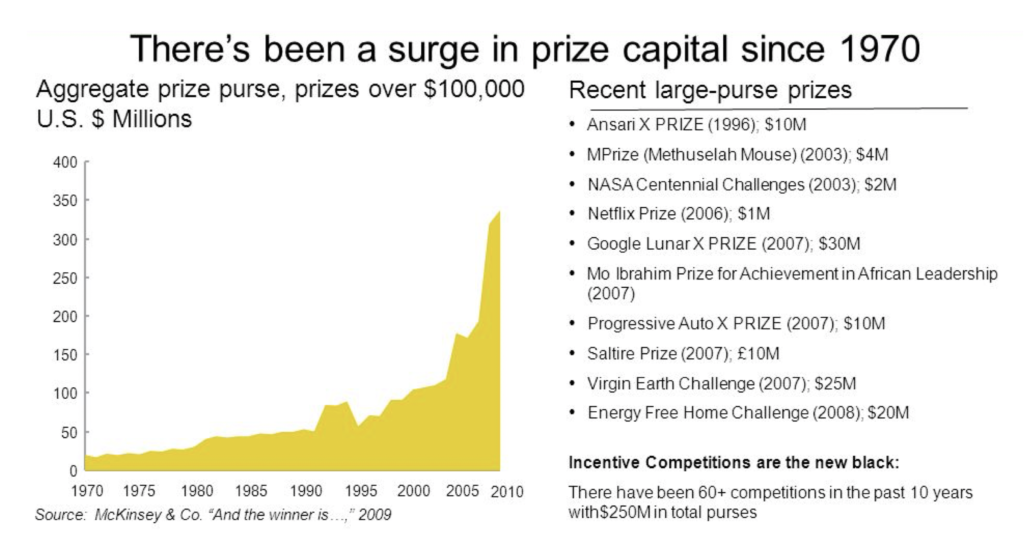
away from traditional arenas such as the arts, which only ten years ago claimed nearly one-third of the large prize purses that we tracked. Today, the arts and humanities-oriented prizes make up less than 10% of the total. By contrast, prize purses focused on climate and the environment, science and engineering, and aviation and space have increased seven-fold and most of that new money goes to those who solve defined problems."

Finally, sponsors are increasingly innovative in the types of prizes they create and bestow. Prizes used to be easy to categorize into one of two major types—“incentive” prizes and “recognition” prizes, or “awards”. But prizes such as Ashoka’s Changemakers initiative (“Changemakers”) or the FIRST Robotics competition are blurring this boundary. The most successful create a demonstration effect for philanthropists looking for compelling new ways that prizes can produce societal benefit."

In sum, a broader range of sponsors is using larger prizes more often—and in more innovative ways—to address a wider array of objectives. Many factors have contributed to this change, including the arrival of new wealth outside of established philanthropic channels, a frustration with conventional approaches to change, different approaches to allocating risk in the development of new ideas and technologies, greater global interconnectedness through the Internet, and an increasingly multi-media and technology intensive world."
Prizes offer sponsors a powerful loudspeaker. As Kevin Bolduc of the Center for Effective Philanthropy has noted, prizes can be “successful in part because they are big and loud.”
For many philanthropists, the ability of prizes to grab attention and influence public perception of a topic or discipline is deeply attractive. There are many examples of well-crafted prizes, backed by a relatively small amount of capital, establishing the importance of a field, catalyzing market demand, shaping public debate, and even changing the image of sponsors.
The Nobel Committee has famously (and at times controversially) used its Peace Prize to influencea variety of political, social, cultural, and intellectual debates, with the express intent of supporting particular individuals or causes.
Many other prizes are geared to do the same, from the Magsaysay Awards in Asia (honoring “persons and organizations as exemplars of selfless leadership, whose lives and work make Asia truly a better place”) to the Bradley Prize in the United States (given annually to individuals who “have made contributions of excellence” consistent with values including “limited, competent government,” “democratic capitalism,” and “a vigorous defense, at home and abroad, of American ideas and institutions”).
Each of these prizes has at times attracted loud criticism, but all are still far more effective at building support for their causesthan any number of advertisements or editorials.
Prizes can be particularly effective at shaping the agendas and behavior of groups and guiding (directly or indirectly) the activity of individuals, institutions, and even whole disciplines.
The $1 million Netflix Prize, for instance, challenges data mining programmers to improve the company’s online movie recommendation algorithm by 10%. Partly by releasing proprietary data of interest to data miners, Netflix has attracted more than 34,000 entrants (many of whom have spent significant hours on the task) and is now within reach of its target.
Ashoka’sChangemakersprogram seeks a similar objective in a different way, using an open source “discovery framework” to frame a set of social problems, such as access to water or sanitation, focusing the problem-solving efforts of a growing community of social entrepreneurs.
A recent Harvard Business School report, The Value of Openness in Scientific Problem Solving, found that “the further the problem was from the solver’s expertise, the more likely they were to solve it.”

The Hague Humanity Hub Fluwelen Burgwal 58, 2511 CJ The Hague, Netherlands
The Hague Humanity Hub Fluwelen Burgwal 58, 2511 CJ The Hague, Netherlands